


Knowing When Courts Apply the Literal Rule and the Purposive Approach: Lessons from the Sterling Holiday Ruling Denying Tax Benefits of Over ₹240 Crore by Income Tax Appellate Tribunal.
Every word in a statute matters, but not every case is decided by its words alone. Knowing when courts apply the Literal Rule and when they adopt the Purposive Approach lies at the heart of judicial interpretation.
Imagine a law stating, “No vehicles are allowed inside the park.” Read literally, even an ambulance entering to save a life would violate the rule. Yet, no one would argue that the law intended to prevent emergency services from entering the park. The objective of the law is to prevent noise, pollution and disturbance, not to obstruct life-saving assistance.
Before examining how this debate played out in a recent tax dispute of 241 Crore, it is useful to understand these two principles.
Literal Rule
The Literal Rule requires courts to interpret a statute according to the ordinary and natural meaning of its words. Where the language is clear and unambiguous, the provision must be applied exactly as written, even if the outcome appears harsh or inconvenient.
Purposive Approach
The Purposive Approach requires courts to interpret a statute by considering the object and purpose behind the legislation. Instead of focusing solely on the literal wording, the court adopts the interpretation that best advances the legislative intent.
The significance of this distinction became evident in the recent Mumbai ITAT ruling in Sterling Holiday Resorts Ltd. v. ITAT, where the interpretation of a single statutory condition resulted in the denial of tax benefits relating to accumulated business losses of over ₹240 crore that were sought to be transferred from the Demerged Company to the Resulting Company.
In this case, the Mumbai ITAT examined whether the Resulting Company was entitled to carry forward the accumulated business losses of approximately ₹240.15 crore under Section 72A of the Income-tax Act. The dispute arose because, instead of the Resulting Company issuing shares to the shareholders of the Demerged Company, the shares were issued by the Holding Company of the Resulting Company. This raised the question of whether the condition prescribed under Section 2(19AA)(iv), which specifically requires the Resulting Company to issue its shares as consideration for the demerger, had been satisfied.
What Happened in Sterling Holiday Resorts India Ltd?
Under the Scheme of Arrangement, the Holiday Activity Undertaking of Sterling Holiday Resorts India Ltd. was transferred to Thomas Cook Insurance Services (India) Ltd., the Resulting Company. However, instead of the Resulting Company issuing shares,
Thomas Cook (India) Ltd., its Holding Company, issued shares to the shareholders of Sterling Holiday.
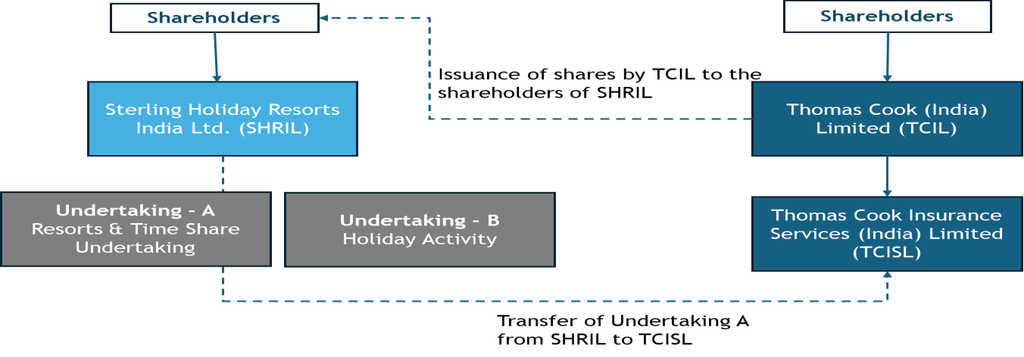
This raised an important question:
Can a demerger qualify under Section 2(19AA) when the Holding Company, and not the Resulting Company, issues the shares?
The Tribunal answered this question in the negative and holds that losses cannot be carried forward and set off in absence of satisfaction of conditions specified under section 2(19AA) IV of the Income Tax Act.
Before analysing the Tribunal’s reasoning, an obvious question arises: Was this the first time such a demerger structure, where shares as consideration were issued by an entity other than the Resulting Company, had been adopted? Surprisingly, the answer is “No”. Several similar schemes had already received approval from the NCLT.
A. Asian Granito India Limited.
The NCLT, Gujarat approved a scheme where the Adicon Tiles Manufacturing Undertaking was transferred to Adicon Ceramics Limited, while the consideration was discharged through the issue of shares by Asian Granito India Limited. The scheme also permitted the transfer of unabsorbed depreciation to the Resulting Company.
B. Cello Group Restructuring.
Wim Plast Ltd. transferred its undertaking to Cello Consumer Products Pvt. Ltd., a wholly owned subsidiary of Cello World Ltd. However, instead of the Resulting Company issuing shares, the consideration was discharged by Cello World Ltd., the Holding Company of the Resulting Company.
C. Ajmera Realty & Infra India Ltd.
An even more interesting structure was approved in the case of Ajmera Realty & Infra India Ltd. Here, the Resulting Company was a wholly owned subsidiary of the Demerged Company. Instead of the Resulting Company issuing shares, the Demerged Company itself, being the Holding Company, issued additional shares to its existing shareholders as consideration. This represented a significant departure from the conventional mechanics of a demerger.
These precedents demonstrate that commercially similar structures have been recognised and approved.
If similar demerger structures had already been approved by the NCLT, where shares were issued by an entity other than the Resulting Company, then why did the Mumbai ITAT still deny the benefit of carry forward and set-off of losses under Section 72A?
The answer lies in the Tribunal’s Literal interpretation of Section 2(19AA). While denying the benefit under Section 72A, the Mumbai ITAT made the following key observations:
• The Supreme Court has consistently held that tax statutes must be interpreted strictly. Where the language of a provision is clear and unambiguous, courts must apply it as written without adding or substituting words.
• Section 2(19AA) grants tax neutrality only if every prescribed condition is fulfilled, including the requirement that the Resulting Company must issue shares to the shareholders of the Demerged Company.
•In the present case, the shares were issued by the Holding Company of the Resulting Company instead of the Resulting Company Itself. Accordingly, the Tribunal held that the mandatory condition under Section 2(19AA) was not satisfied.
•The Tribunal further observed that a Holding Company and its subsidiary are separate legal entities. Therefore, a Holding Company cannot discharge a statutory obligation that the law specifically imposes upon its subsidiary.
Accordingly, the Tribunal held that the demerger did not satisfy the conditions prescribed under Section 2(19AA) and denied the benefit of carry forward and set-off of losses under Section 72A.
Conclusion:
The Sterling Holiday ruling is a reminder that statutory interpretation is not merely a rule of construction but can determine the fate of an entire transaction. While the Tribunal preferred the Literal Rule, the existence of similar NCLT-approved schemes keeps the debate on purposive interpretation alive. As higher courts examine the issue, the decision may ultimately clarify whether, in tax law, words alone prevail or legislative intent also has a role to play.
*https://aglasiangranito.com/Intimations_Disclosures/Draft-Scheme-of-Arrangement.pdf
**https://nsearchives.nseindia.com/corporate/CELLO2023_15052026192852_CWL_Upload_Signed.pdf
***https://ajmera.com/wp-content/uploads/2024/07/NCLT-order-approving-the-Scheme-of-Arrangement.pdf?utm
The article is written by
Ankur Shukla – Deputy Manager