

On Stress Awareness Day, a look at how pressure shapes judgement around the board table — and the disciplines that help
A promoter hears an independent director’s question as an accusation and thinks: “Do they understand what it took to build this company?” The director, working from incomplete information, wonders: “How can I approve something I cannot properly assess?”
Both want the company to succeed. Yet each experiences the other’s behaviour as a threat.
The agenda records the business issue. It rarely records the emotional weight behind it.
Over the years, I have seen difficult boardroom conversations become harder when the issue at hand begins to feel personal.
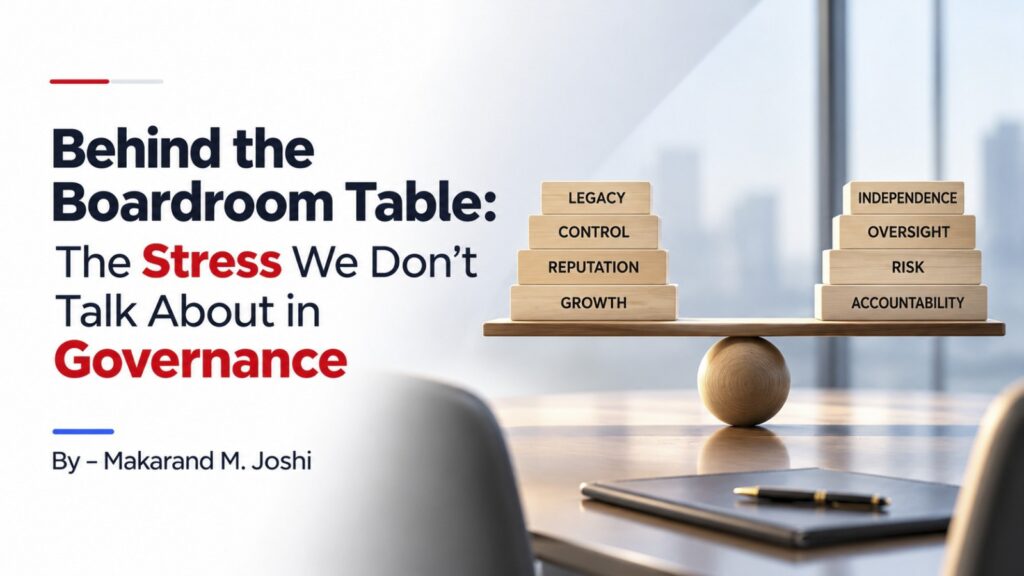
Stress Awareness Day usually prompts conversations about workload, burnout and wellbeing. We talk far less about the pressure carried into rooms where consequential decisions are made. The boardroom is one of them. And once that pressure begins to shape judgement, information flow and behaviour, stress stops being only a wellbeing issue. It becomes a governance issue.
Why the pressure becomes personal
For many promoters, the company is identity, sacrifice, family security and legacy. A question about strategy can feel like a question about competence. Delegation can feel like losing relevance; succession, like displacement.
Independent directors carry a different weight: the expectation of independent judgement with limited operational visibility. They worry about missing warning signs, straining relationships by pressing too hard, or staking their reputation on misplaced trust.
Promoters may need recognition for what they have built. Independent directors may need information, candor and confidence that disagreement will be heard. Neither need is unreasonable. The trouble starts when these needs go unspoken and begin to steer decisions. The same dynamic plays out between a CEO and the board, a CFO and the audit committee, or a founder and the team being prepared for succession. Governance defines the roles; people still occupy them.
How it spreads
Take a proposal to support a struggling group company. The promoter sees employees, relationships and years of effort. The independent director sees exposure, conflicts and thin justification. Watching the standoff, employees hold back bad news, auditors start to look obstructive, and management shares less just as directors question more sharply. Unspoken anxiety becomes organisational behaviour.
Six disciplines for pressure in the boardroom
Recognizing the pressure is only useful if it helps us respond differently. The aim is not a less demanding boardroom, but one where pressure does not distort judgement, communication and trust. Six practical disciplines can help.
1. Name the emotion before debating the decision. Before a difficult meeting, ask: “Am I concerned about the proposal, or do I feel distrusted, excluded or exposed?” A promoter can acknowledge discomfort without rejecting scrutiny; a director can acknowledge uncertainty without assuming dishonesty.
2. Replace interpretations with specific questions. Not “You never trust management,” but “What information would help you assess this?” Not “Management is hiding something,” but “Which facts are missing, and when can we have them?” Specific questions make concerns actionable.
3. Respect the person while testing the proposal. A director might say: “I understand why this matters to you. Let us test whether the company can bear this exposure.” A promoter might reply: “Help us identify the safeguards that would make this acceptable.” Neither surrenders judgement.
4. Reduce avoidable uncertainty through process. Circulate papers early, explain assumptions, give access to the right executives and track open questions. Clear lines between board oversight and management execution spare everyone from renegotiating access and trust at every meeting.
5. Make room for disagreement before positions harden. The Chair should notice interruptions, silences and exchanges turning personal. A pause or a private conversation can restore perspective, but material concerns must always return to the board process.
6. Protect the capacity for sound judgement. Promoters should build leaders who can carry real responsibility; directors should ask whether their commitments leave time to prepare properly. Pressure follows people home, so recovery deserves attention too: time to switch off, rest, a candid conversation with someone trusted, and professional support when distress persists. Where stress is already showing, contain it: no angry messages, protection for those raising concerns, and facts verified before anything is communicated.
Vulnerability does not dilute accountability
None of this changes anyone’s responsibilities. Independent directors must still scrutinise management and pursue legitimate concerns. Promoters and management remain accountable for their conduct. Section 149(12) of the Companies Act limits the liability of independent and non-executive directors in defined circumstances; it is not immunity. Pressure is never an excuse for concealment or weak oversight.
But good governance can hold two ideas at once: people remain accountable for their decisions, and the quality of those decisions depends on the conditions in which judgement is exercised.
That is the conversation worth having today. Not whether boardrooms should be less demanding, but whether we can build boardrooms where hard questions are asked without becoming personal, uncertainty can be admitted without looking like weakness, and challenge improves decisions instead of damaging relationships. A well-governed company makes room for human vulnerability while preserving institutional discipline.
POST COPY:
In my years alongside boards, I’ve seen one workplace consistently left out of the stress conversation: the boardroom. With this year’s Stress Awareness Day theme being “Rehumanising the Workplace”, it felt right to bring it up.
A promoter hears a hard question as an accusation.
An independent director fears the warning sign they might be missing.
Neither says it out loud.
The minutes record the decision. Never the pressure behind it.
That’s when stress stops being a wellbeing issue and becomes a governance issue.
Six disciplines I’ve seen work, in the article below.
If you sit on a Board, or regularly report to one: what helps keep difficult disagreement constructive when the stakes become personal?
And if this resonates, I would be interested in hearing your views and experiences.