The recent Nobel Prize in Economic Sciences awarded to Joel Mokyr has illuminated a profound truth: sustained growth is a cultural phenomenon, not an automatic process. For us at MMJC, a firm dedicated to serving the community through diligent and thoughtful research, this recognition resonates deeply. It affirms our core belief that the pursuit of knowledge is a continuous, collaborative, and ultimately, a humble endeavor.
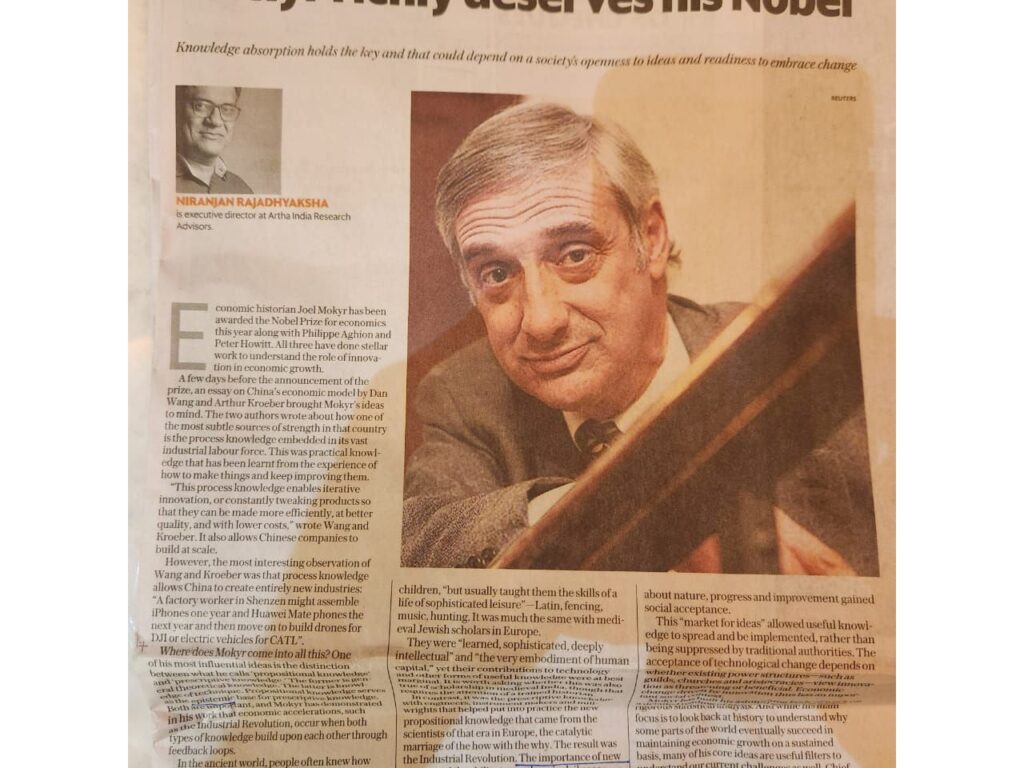
The insightful articles by Niranjan Rajadhyaksha, Allison Scharger, and Aditya Sinha in Mint, published consecutively last week, provided a much-needed spotlight on Mokyr’s wisdom. They beautifully illustrated that for innovation to flourish, a culture must first value it. Growth is not a top-down directive, but a shared journey fueled by open communication, rigorous peer review, and a willingness to trust and collaborate.
Incidentally, this message served as a powerful backdrop for our research team’s session on October 16th. We gathered not to celebrate past successes, but to ask: How can we serve our clients and the community even better? Inspired by Mokyr’s framework, we engaged in an open and path-breaking interaction, exploring our purpose, methodologies, and the parameters that guide our research.
Click here to know more!

Time is the only resource that treats all of us the same — and what truly sets professionals apart is how intentionally we choose to plan and use it.
In our recent Time Management & Planning session at MMJC, we discussed something simple yet powerful: when we plan with clarity and purpose, efficiency stops being a task – it becomes a way of working together.
It turned into a meaningful conversation — and a gentle reminder that mastering time really begins with mastering our attention.
Click here to know more about the session.
“योगस्थः कुरु कर्माणि सङ्गं त्यक्त्वा धनञ्जय” – Perform your duty with steadiness, abandoning attachment to success or failure.
I’ve always found this verse deeply relevant to governance and professional practice. It’s a reminder that the quality of our work should never depend on whether it brings praise, profit, or recognition. Our responsibility is to the standard itself — to clarity, integrity, and doing what is right, regardless of outcomes.
Clarity, purpose, and duty-driven decision-making create sustainable outcomes and maximise long-term value, even in difficult moments.
On this Gita Jayanti, I’m reminded that the best guidance is timeless — and this teaching remains as relevant today as it was centuries ago.
In this video, we have covered the latest amendments to SEBI (LODR) Regulations with a clear focus on Material Related Party Transactions (RPTs) and the newly introduced scale-based thresholds. Inside this podcast:
1. Scale-Based Thresholds for Material RPTs — Regulation 23(1) – Schedule XII-based criteria
2. New Thresholds for Material RPTs — Regulation 23(2) – Applicable to subsidiary companies
3. Additional Amendments This amendment will significantly change how companies evaluate, approve, and disclose RPTs, bringing more transparency and proportionality based on size and risk.
Don’t forget to Like, Share & Subscribe!
Bhagavad Gita 18.67 reminds us: knowledge is sacred, and only those with discipline, trust, purpose, and humility are ready to receive it. True learning doesn’t just shape the mind—it transforms the entire life.
For the first time in years, investor sentiment is shifting from hype to hard questions — and the numbers prove it.
With only 15% IPOs delivering >25% listing gains in 2025 (vs 41% in 2024) and 38% of recent IPOs trading below issue price, the message is clear:
valuation discipline is no longer optional — it’s survival.
SEBI’s recent caution reinforces what the market is already signalling:
retail trust is fragile, and aggressive pricing without fundamentals will not be rewarded.
Our latest breakdown explores why:
India’s IPO cycle is entering a new phase
Investors are choosing clarity over stories
Disclosure quality is the new differentiator
Post-listing performance is becoming the real credibility test
The primary market isn’t slowing down — it’s demanding better.
We’re celebrating Pradnesh Kamat 5-year journey with MMJC — a journey that began during the Covid years, as he transitioned from the corporate world to MMJC.
What makes this milestone truly special is his faith in MMJC’s vision and his unwavering commitment to MMJC values.
His calm leadership and composed approach make him truly unique, inspiring everyone around him to bring their best every day.
Here’s to celebrating the impact, dedication, and excellence Pradnesh continues to bring to every responsibility at MMJC.
Can transparency influence investor sentiment even before an IPO hits the market?
In India’s evolving IPO landscape, the Grey Market Premium (GMP) often dominates headlines — but it’s the ICDR disclosures that truly shape trust. Our latest insight decodes how transparent reporting of Key Performance Indicators (KPIs) and financials under the SEBI (ICDR) framework helps bridge the gap between speculation and substance.
Because in capital markets, perception may start with price —
but confidence begins with clarity.
Read more
In today’s world of instant communication, speed often takes priority.
However is sending the board meeting notice via WhatsApp legally sound? Lets dive in the NCLT order passed by Kochi bench.
Swipe through to see how one company’s informal approach to board notices became a legal lesson.
It’s a reminder that growth shines brighter when it’s shared.
And that every spark of creativity, warmth, and teamwork adds to the light we all create.
As MMJC filled with lights, color and the quiet joy of togetherness, we were reminded that true celebration isn’t in grandeur — it’s in gratitude.
Gratitude for the people who make every day purposeful, for the bonds that turn colleagues into a family, and for the culture that continues to grow brighter with every passing year.
Because when a workplace glows with shared purpose and pride, it doesn’t just celebrate Diwali — it becomes the festival of light. ✨
Wishing every one brightness and happiness in work life and beyond