

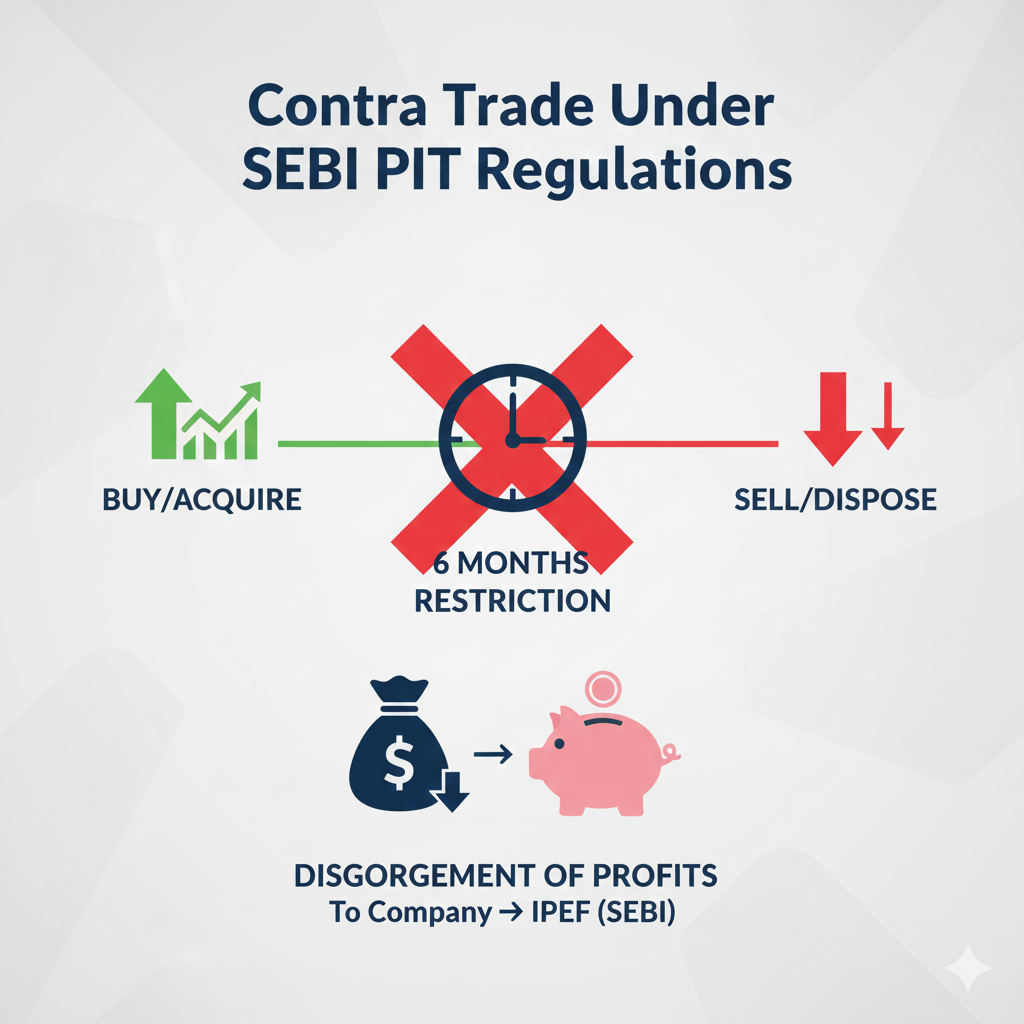
Question 1.
| Scenario 1 | Scenario 2 |
| Pledging of sharesUn-pledging/ revocation of sharesRe-pledging of shares within the same month Would this sequence be considered a contra trade? Whether answer will differ in case of invocation? | Pledging of sharesUn-pledging/ revocation of sharesSale of ESOP-allotted shares in the open market Does the un-pledge followed by sale of ESOP shares amount to a contra trade? |
Answer:
| Scenario 1 | Scenario 2 |
| Under Regulation 2(1)(l) of the SEBI (PIT) Regulations, 2015 read with SEBI’s recent informal guidance[1], trading includes creation, invocation or revocation of a pledge. Accordingly: Creation of pledge = a “trade” Revocation / release / un-pledge = an “opposite trade” Invocation of pledge (on loan default) = results in transfer of beneficial ownership and is treated as a trade that may attract contra restrictions. However, that pledging and un-pledging do not amount to contra trades, unless the pledge invocation results in a change in beneficial ownership. Mere pledge or release is only a security arrangement and does not result in change in beneficial ownership or acquisition or disposal of shares in the market. | Exercise or grant of ESOP is not a trade.[2] Trading would include creation/invocation/revocation of pledge. Sale of ESOP purchase shares will be a trade, however, will not amount to contra trade to unpledged/revocation as beneficial ownership did not change when pledge was revoked or released. Let’s say 100 shares were allotted vide exercise of ESOP later those 100 shares were pledged and then un-pledged (release). Now sale of 100 ESOP shares within 6 months of revocation/ release will not amount to contra trade as beneficial ownership did not change while creation and revocation/ release of pledge. |
Question 2.
Consider the following sequence of events:
A Designated Person had previously purchased 100 shares on the open market more than six months ago.
After the expiry of that six-month period, the person received an ESOP allotment, and those ESOP shares were subsequently pledged and un-pledged.
Now, within six months from the ESOP allotment, the person proposes to sell the earlier 100 market-purchased shares (not the ESOP shares).
In this situation, would the sale of the 100 market-purchased shares amount to a contra trade under the PIT Regulations, even though the ESOP shares were allotted, pledged, and un-pledged during this period?
Answer:
The DP’s purchase of 100 shares occurred more than six months ago, so the mandatory six-month period for that leg has already elapsed.
The pledge and un-pledge of ESOP shares do not result in change of beneficial ownership and therefore do not trigger contra-trade restrictions.
Accordingly, selling the earlier 100 market-purchased shares within six months of the ESOP allotment/pledge/un-pledge will not be considered a contra trade.
Question 3.
A promoter sold 1000 shares on April 01, 2025, in open market, later he acquires 100 shares on May 01, 2025 and 100 shares on June 01, 2025. Is this contra once or twice?
Answer:
Contra trade restrictions are applicable on date wise.[3] Promoter has sold shares on April 01, 2025, the person cannot take a reverse position for a period of 6 months from last leg of buy transaction.
Accordingly, the purchases dated May 01, 2025, and June 01, 2025 each independently amount to two separate contra trades in relation to the sale executed on April 01, 2025.
Question 4.
A designated person was allotted 100 shares pursuant to the allotment of rights issue dated June 01, 2025. Later, on July 20, 2025, he was allotted 100 shares pursuant to exercise of ESOP. He intends to sell shares in open market on November 01, 2025. Can he do so?
Answer:
If the initial transaction is an acquisition by way of Rights issue, Follow-on Public Offer (FPO), Offer for Sale (OFS), Bonus issue, Share Split, Merger/Amalgamation, Demerger, then subsequent disposal of securities within 6 months from the date of initial transaction would be considered as a contra trade. Similarly, if the securities are disposed through Buy-back or Open offer, then subsequent acquisition of securities within 6 months from the date of initial transaction would be considered as a contra trade. [4]
Exercise of ESOP is not considered as trade. However, Allotment of securities by way of rights issue is a trade (Acquisition). Subsequent disposal/ sell in open market would amount to contra trade.
Question 5.
If a promoter sells shares in the open market and then, within six months, buys shares from another promoter through an inter-se transfer on the stock exchange, does this violate the PIT Regulations?
Further, if the same promoter, then wants to sell those acquired shares again in the open market within six months of the inter-se transfer, will this amount to a contra trade violation?[5]
Answer:
In case of a promoter who earlier sold shares in the open market and then buys shares from another promoter on the stock exchange by way of inter se transfer within six months, it will amount to contra trade as the defence available is for off-market inter-se transfers under the proviso to Regulation 4(1)(i).
Question 6.
If a promoter–director (Mr. P) holds shares in the company under multiple capacities:[6]
(i) his personal PAN,
(ii) as a trustee for his family,
(iii) as a trustee for other beneficiaries, and
(iv) as an executor of wills
then:
- Will he be treated as a designated person only for the shares held in his personal capacity, or for shares held in all capacities?
- If he is treated as a designated person for all capacities, will contra-trade restrictions apply collectively to all such holdings under his PAN?
Example: If he sells shares as an executor, is he barred from buying shares in his personal capacity within six months?
- Do contra-trade restrictions apply to shares held in a trust where Mr. P is not the PAN holder, but other trustees hold the shares?
Answer:
Regulation 9 (4) of the PIT Regulations, inter alia, specifies the persons to be identified as ‘designated person’ on the basis of role and function in the organization and the access that such role and function would provide to the unpublished price sensitive information (UPSI).
The term ‘designated person’ is wide enough to include any person having such role and function in the organization which would provide access to UPSI to such person in the opinion of the board of directors after consultation with the compliance officer. So Mr. P would be identified as a designated person by virtue of his role and access to UPSI.
Once a person is classified as a designated person the contra-trade restrictions under Clause 10 of Schedule B apply to all shares held under his PAN, regardless of the capacity in which he trades.
Hence in case of Mr P all securities held under his PAN, whether held:
- in his personal capacity,
- as a trustee for family members,
- as a trustee for other beneficiaries, or
- as an executor of wills,
buying and selling of same within six months would amount to contra trade.
Question 7.
A company listed on BSE, has issued warrants to its Promoters / Promoter Group. As part of a succession planning exercise, the Promoter Group now intends to move their entire shareholding both existing shares and shares that will arise on warrant conversion into their respective family trusts (“Transferee Trusts”).
The proposed steps are:
(a) converting the outstanding warrants into equity shares, and
(b) transferring shares off-market by way of gift among certain promoter family members so that the holdings are consolidated with Promoter X and Promoter Y.
In this context, Promoter Y seeks clarification on two points:
- If promoters receive shares on conversion of warrants, and then transfer those shares off-market to other promoters within six months, will this violate the contra-trade restrictions under the PIT Regulations?
- If promoters acquire shares from other promoters (either through off-market transfers or block deals), can they transfer those shares to their family trusts within six months, or would this be treated as a contra-trade violation?[7]
Answer:
First, when the promoters convert warrants into equity shares, that is treated as an acquisition (buy leg).
If they sell or transfer those shares (whether by inter-se off-market transfer or block deal) within six months of such conversion, this may amount to a contra trade, because it is an opposite transaction (sell) within six months of a buy.
Similarly, if promoters or members of the promoter group acquire shares through inter-se off-market transfers or block deals from other promoters, and then transfer those shares to acquirer/family trusts within six months, this may also attract contra-trade restrictions under the PIT Regulations.
Question 8.
Are PIT Regulations applicable on transmission of shares?
Answer:
Yes, PIT Regulations are applicable on transmission of shares. However, they are exempted from provisions of trading window closure, pre-clearance and contra trade, but the norms relating to disclosure requirements shall be applicable on transmission of Shares
Question 9.
Are contra trade restrictions applicable to trades executed under trading plan?
Answer:
Yes, contra trade restrictions are applicable in case of trading plan. Contra trade restrictions are also applicable to trades executed under two separate trading plans.[8]
Question 10.
Mr. A holds 1,50,000 equity shares of XYZ Ltd. in one Demat Account. He internally transfers 50,000 shares to Demat Account 2, both accounts being held under the same PAN and same beneficial ownership[9].
Answer:
A transfer between two Demat accounts held by the same individual with the same PAN does not amount to a change in beneficial ownership. It will not be treated as trading and disclosure requirement will not be applicable.
Question 11.
5,000 shares were allotted to Mr. V on November 18, 2025, pursuant to the exercise of ESOPs. Mr. V sold 500 ESOP-acquired shares on November 21, 2025. His father (an “immediate relative” as defined under the PIT Regulations) now wishes to purchase a few shares from the open market on November 27, 2025. Will this amount to a contra trade?
Answer:
Exercise of ESOPs is not regarded as a “trade” under the PIT Regulations, as clarified by SEBI through multiple Informal Guidance letters and FAQs. The subsequent sale of ESOP-acquired shares is, however, a “trade”, but it is not treated as a contra trade to the event of exercise of ESOP.
In this case, once Mr. V has sold 500 shares on November 21, 2025, any acquisition of shares by Mr. V or his immediate relative (his father) within six months of that sale will constitute a contra trade, since the contra period applies collectively for designated persons and their immediate relatives.
Question 12.
On November 11, 2025, Mr. P (designated person) acquired 500 shares. Whether sale of 500 shares by his wife who is not financially dependent on Mr. P will amount to contra trade?
Answer:
The definition of states that, “immediate relative” means a spouse of a person, …
Spouse of a person is deemed to be immediate relative irrespective of financial dependency or trading-decision influence.
Hence, sale of 500 shares by wife of Mr. P will amount to contra trade.
Question 13.
On November 11, 2025, Mr. P (designated person) acquired 500 shares. Whether sale of 500 shares by his father who is not financially dependent on Mr. P will amount to contra trade?
Answer:
The definition of states that, (f) “immediate relative” means a spouse of a person, and includes parent, sibling, and child of such person or of the spouse, any of whom is either dependent financially on such person, or consults such person in taking decisions relating to trading in securities; Spouse of a person is deemed to be immediate relative irrespective of financial dependency or trading-decision influence.
In case of parent, sibling and child financial dependency or trading-decision influence are essential elements.
Hence, sale of 500 shares by father of Mr. P will not amount to contra trade as his father is not immediate relative and not governed by code of conduct under PIT Regulations.
Question 14.
One individual promoter sells shares in June. Another individual member of the promoter group (but a different individual) wants to buy shares in August. Are contra trade restrictions applied to the promoter group collectively or only promoter-wise individually?
Answer:
As per the provisions of regulation 9 of the PIT Regulations and clause 3 of Schedule B to the PIT Regulations, the contra trade restrictions apply to trades made by promoters individually and not the entire promoter group. [10] Hence, taking SEBI’s view in the matter of Raghav Commercial Ltd. the restriction shall apply to each promoter individually. Hence contra trade restrictions would not be applicable
Question 15.
Two subsidiaries, Subsidiary X and Subsidiary Y, are both part of the same promoter group and fully controlled by the same parent. Subsidiary X buys shares of the listed company in January. Subsidiary Y wants to sell shares in March. Will the sale by Subsidiary Y be treated as a contra trade, given that both entities are under common control?[1]
Answer:
SEBI has given an informal guidance for a similar situation. In the matter of Rama Mines (Mauritius) Ltd. SEBI has stated that “when both subsidiary companies are ultimately controlled by the same parent entity, provision of contra trade restrictions shall apply. Hence in the given case Rama Mines (Mauritius) Ltd. (RMML) and Australian Indian Resources Ltd. (AIRL) are jointly controlled., if AIRL has purchased the shares… then restriction on contra trades shall apply to AIRL as well as RMML.” In simpler terms, the combined actions of entities or persons under a common control are treated together for the purpose of applying contra trade restrictions
Question 16.
Mr. A, an employee of XYZ Limited (a listed company), has been freely trading in the shares of XYZ as a normal employee.
On March 10, 2025, when he is not a Designated Person, he buys 1,000 shares of XYZ Limited.
With effect from June 01, 2025, Mr. A is identified as a Designated Person under the company’s Code of Conduct framed under Regulation 9 and Clause 10 of Schedule B of the SEBI (PIT) Regulations, 2015.
On July 02, 2025, Mr. A sells 1,000 shares of XYZ Limited.
Answer:
No, the sale on July 02, 2025, should not be treated as a contra trade to the buy on March 10, 2025, because the March trade was executed when Mr. A was not a Designated Person.
As per Clause 10 of Schedule B read with Regulation 9 of the SEBI (PIT) Regulations, the 6-month contra-trade restriction applies to Designated Persons.
SEBI in the matter of Marksans Pharma Limited[1] has noted that,
“I note that the restriction on executing contra trades becomes applicable when any person becomes a Designated Person, as per the Code of Conduct of the company..
Since Noticee No. 1 became a Designated Person w.e.f. May 30, 2015, after the first Buy trade on 10/06/2015 for 100 shares, Noticee No. 1 could not have sold shares within a period of 6 months after this date..
.. However, any holding of the designated person prior to becoming the designated person would also need to be sold by him in a way that does not breach the contra trade norms after he became the designated person..” In simple way the trades executed before a person becomes a Designated Person should be excluded from contra-trade computation, though any holdings acquired prior to designation must thereafter be dealt with in a manner that does not breach the contra-trade norms going forward.
Question 17.
Mr. A, a Designated Person of XYZ Limited, executes multiple contra trades during the quarter. His trades result in a gross profit of ₹32,80,000, but after adjusting certain losses on other trades during the same period, his net profit comes to only ₹18,40,000.
Mr. A offers to disgorge only the net profit, claiming that losses should be set off against gains.
For the purpose of disgorgement of profits arising from contra trades under the PIT Regulations, should Mr. A be required to remit gross profit or net profit?
Answer:
Under Clause 10 of Schedule B to the SEBI (PIT) Regulations, the obligation to disgorge profits from contra trades refers to “profits from such trade”. In the matter of Swan Energy Limited[1], where SEBI directed the designated person to disgorge the entire gross profit of ₹30,25,133 arising from contra trades, despite the noticee having initially deposited only the net/actual gain. SEBI expressly required that the gross profit amount be remitted to the SEBI-IPEF
Question 18.
Can a Designated Person create a pledge on shares of the company during trading window closure?
Answer:
Yes, a Designated Person may create a pledge on shares during trading window closure, provided the pledge is for a bona fide purpose, such as raising funds, and is subject to pre-clearance by the Compliance Officer and compliance with applicable SEBI regulations.
SEBI has clarified that trading window restrictions under Clause 4(3)(a) of Schedule B to the PIT Regulations do not apply to pledge of shares for bona fide purposes, such as raising funds.[1]
Question 19.
Answer:
Clause 4(3)(a) of Schedule B provides that trading window restriction do not apply to pledge of shares if done for bonafide purpose such as raising of funds. ‘Such as’ is inclusive and illustrative, and not exhaustive or exclusive as stated by SEBI in Informal guidance Avenue Supermarts. While pledge of shares for raising of funds is expressly exempted from trading window restrictions, PIT do not provide for list of all bona fide purposes.
Such purposes are not automatically approved. They may be considered bona fide depending on facts and supporting documents.
The Compliance Officer should evaluate each request on a case-to-case basis and may grant pre-clearance only if the purpose appears genuine, documented, and not in violation of PIT Regulations.
Identification of bonafide transactions may be done as per classification provided in code of conduct formed to regulate, monitor and report trading by DPs. Provided that such classification is not in violation of the PIT Regulations and such other SEBI regulations, if applicable.
Question 20.
Answer:
Invocation of pledge results in change in beneficial ownership and may be considered akin to sale of shares. However, SEBI clarified that invocation of pledge by itself may not be construed as contra trade, provided the Designated Person has not undertaken any acquisition of shares, other than by way of ESOP exercise, within six months prior to or subsequent to invocation.
Therefore, the contra trade analysis will depend on the nature of transactions undertaken within the six-month period before or after invocation.[1]
[1] SEBI | Informal Guidance by way of an Interpretive Letter under the Securities and Exchange Board of India (Informal Guidance) Scheme, 2025 received from Avenue Supermarts Limited in relation to the provisions of the Securities and Exchange Board of India (Prohibition of Insider Trading) Regulations, 2015
[1] SEBI | Informal Guidance by way of an Interpretive Letter under the Securities and Exchange Board of India (Informal Guidance) Scheme, 2025 received from Avenue Supermarts Limited in relation to the provisions of the Securities and Exchange Board of India (Prohibition of Insider Trading) Regulations, 2015
[1] https://www.sebi.gov.in/enforcement/informal-guidance/nov-2025/in-the-matter-of-welspun-corp-limited-under-sebi-prohibition-of-insider-trading-regulations-2015-_97595.html
[2] https://www.sebi.gov.in/enforcement/informal-guidance/jan-2016/informal-guidance-issued-in-the-matter-of-kpit_31577.html
SEBI FAQ dated December 31, 2024- https://www.sebi.gov.in/sebi_data/faqfiles/apr-2025/1744784643061.pdf
[3] Question 43- SEBI FAQ dated December 31, 2024- https://www.sebi.gov.in/sebi_data/faqfiles/apr-2025/1744784643061.pdf
[4] Question 40- SEBI FAQ dated December 31, 2024- https://www.sebi.gov.in/sebi_data/faqfiles/apr-2025/1744784643061.pdf
[5] SEBI | Informal Guidance in the matter of Star Cement Ltd
[6] SEBI | Informal Guidance in the matter of Arvind Ltd. under SEBI (Prohibition of Insider Trading) Regulations, 2015
[7] https://www.sebi.gov.in/enforcement/informal-guidance/feb-2020/in-the-matter-of-nimish-upendrabhai-patel-under-sebi-substantial-acquisition-of-shares-and-takeovers-regulations-2011-sebi-prohibition-of-insider-trading-regulations-2015-and-sebi-issue-of-ca-_45888.html
[8] Question 16G- SEBI FAQ dated December 31, 2024- https://www.sebi.gov.in/sebi_data/faqfiles/apr-2025/1744784643061.pdf
[9] SEBI AO in the matter of NS Agarwal Trading Corporation dt: December 24, 2021, page 23, point 17
[10] SEBI | In the matter of Raghav Commercial Limited under SEBI (Substantial Acquisition of Shares and Takeovers) Regulations, 2011 and SEBI (Prohibition of Insider Trading) Regulations, 201
[12] https://www.sebi.gov.in/enforcement/orders/mar-2021/order-in-the-matter-of-marksans-pharma-limited-_49413.html