

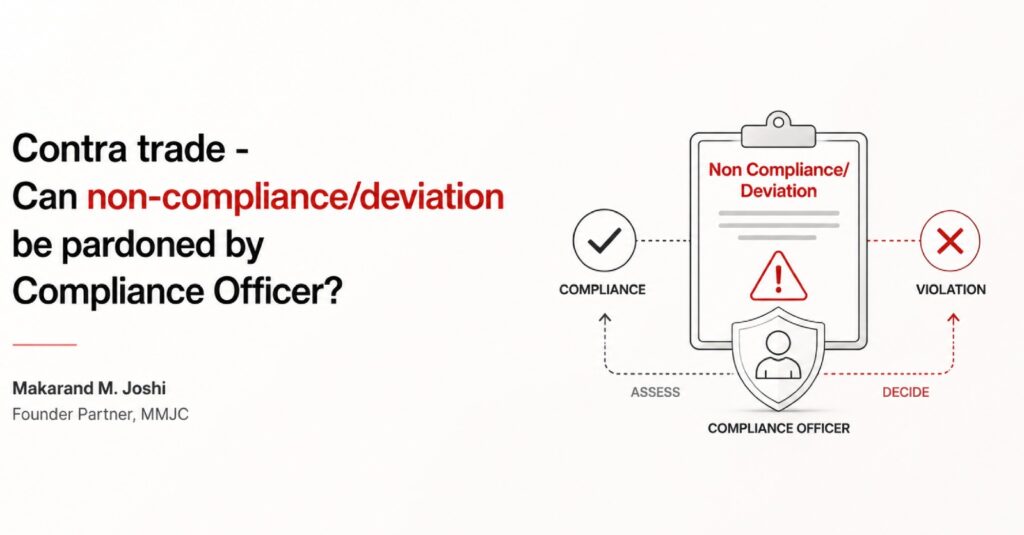
Contra trade is the one of the restrictions where compliance officer can grant relaxation. This statement itself is matter of debate and deliberation in corporate world.
SEBI (Prohibition of Insider Trading) Regulations, 2015 [PIT Regulations] has a very intelligent and unique structure. If you have UPSI you cannot share it unless it is need to know and legitimate purpose subject to certain compliances AND you cannot trade while in possession of UPSI. And then there are few more restrictions arising from model of code of conduct i.e. trading window closure, preclearance and contra trade.
Contra trade, in certain circumstances trade during window closure arising from pledge are few examples where compliance officer has power to grant certain relaxations.
What is contra trade?
As the word reflects there should be two trades and it should be contra i.e. opposite trades. Term trade is defined but contra is not defined. For example, buy and sell are opposite trades or sell and buy are opposite trades. Though trade includes pledge [give reference of definition] but when it comes to meaning of contra, SEBI has taken a view that unless because of trade beneficial ownership is changing it will not be a contra trade [though is considered as trade]. this is one fine line between ‘trade’ under PIT Regulations, and ‘contra trade’ under para 10 of model code of conduct. And this is very logical.
Power of Compliance Officer w.r.t. Contra Trade
In contra trade
- the compliance officer may be empowered to grant relaxation from strict application of such restriction.
- for reasons to be recorded in writing
- provided that such relaxation does not violate these regulations
each of this condition is important, your code of conduct should empower compliance officer to grant relaxation for reason to be recorded in writing. However, he has to ensure that such relaxation does not violate these regulations.
Code of conduct must prescribe period, which in any event shall not be less than six months, within which a designated person who is permitted to trade shall not execute a contra trade. Customarily companies keep same period of six months but not every company is conscious about providing authority to compliance officer to grant relaxation. In absence of such express power, it will be presumed that Compliance Officer has no power to grant any relaxation and legal consequence will follow.
Grounds under which relaxations can be granted
First and foremost, compliance officer must ensure that trade is not in violation of regulation. Violation of regulation would cover –
- trades executed when person was not having any UPSI
- trades not done when window is closed for him
- trades are done either with proper pre clearance from compliance office OR transaction value should be below the threshold prescribed for minimum pre clearance.
Conservative view says if trade is executed within 6 months it will be presumed to be violative of regulations. However, there is legal doctrine which says that any interpretation which makes any line redundant is not a correct interpretation.
If compliance officer is satisfied about all above conditions, then subject to stipulations mentioned in code of conduct, compliance officer can grant relaxation subject to recording reason in writing. Stipulations mentioned in code of conduct can be some specific situations under which such relaxation can be granted by him for example –
- Trade is not done while in possession of UPSI /or when trading window was closed OR not to override requirement of pre clearance
- when there is no change in beneficial ownership like transfer between two where beneficial ownership is not changing OR
- change is within immediate relatives or
- change is within stipulated grounds narrated in proviso to regulation 4(1) of PIT regulations etc.
Code of conduct adopted by the company has to expressly empower Compliance officer and can give him some framework which he can adopt while granting relaxations. If code of conduct is silent about such power to compliance officer, he cannot grant any relaxation, and legal consequences will have to be followed. This power cannot be presumed; it has to be express in enough words in code of conduct.
Recording reason in writing
This is important that compliance officer records his reason in writing while granting relaxation. If relaxation is granted without recording reason in writing, compliance officer would be personally at fault and can suffer legal consequences.
Any power to grant relaxation from main rule must be exercised judiciously. And in order to prove that such exercise of power is not arbitrary it is in best interest of compliance officer to record full details and elaborate reasons why he/she feels that
- trade is not done in violation of regulations; and
- relaxation should be granted for the given case.
If compliance officer observes opposite trade within a period prescribed in code of conduct, it would be prudent for compliance officer to send notice/ communication explaining his observation and seeking response within some stipulated time with all back-ups as to why this should not be considered as violation of regulation and why no action should be taken.
Disgorgement of profit
Contra trade is one such restriction where apart from penal action which a company can take and report to stock exchange, it also has to disgorge profits made during that trade.
Para 10 of model code of conduct says – ‘Should a contra trade be executed, inadvertently or otherwise, in violation of such a restriction, the profits from such trade shall be liable to be disgorged for remittance to the Board for credit to the Investor Protection and Education Fund administered by the Board under the Act.’
This clause is clear that whether trade is inadvertent or otherwise, profits shall be liable to be disgorged. Word ‘shall’ is important here. There is no discretion. Profits ‘shall’ be liable to be disgorged.
There are few more important words to be noted. It says ‘trade in violation of such restrictions’, we have seen in earlier para, it says compliance officer can grant relaxation if ‘trade is not in violation of these regulations’. When different words are used at different place it means different thing. And therefore, even if compliance officer observes that trade is not in violation of regulation but in violation of such restriction [for example 6 months] profits from such trade shall be liable to be disgorged.
Such disgorged profits will have to be remitted to Investor Protection and Education Fund [IPEF] administered by the Board under the Act. Though there is no timeline prescribed within which such disgorgement has to be done AND within what time such disgorged profits will have to be transferred to IPEF at the earliest. The word ‘shall’ makes it mandatory and therefore there is no reason why such disgorgement and transfer should be delayed. In fact, disgorgement is a concept which is triggered to avoid any siphoning of funds
What is considered as trade while ascertaining contra trade
Compliance Officer has to be mindful for evaluating whether there is contra trade or not, many type of transactions will have to be evaluated. Word trade is defined and therefore it includes buy, sell, pledge, un pledge, gift, off market transfer, lending of shares, shares offered as margin etc. the only exception is exercise of ESOP. Exercise of ESOP is not considered as trade for the purpose of these regulations. SEBI in its frequently asked questions have given elaborate guidance on contra trade in context of ESOP as discussed above trade which triggers change in beneficial ownership and is opposite in nature only will be considered as contra trade
Conclusion
While dealing with contra trade compliance officer has to be mindful about various aspects. While model code allows companies code to empower compliance officer to grant relaxation from contra trade restrictions, as per definition of ‘compliance officer’ he is personally responsible to ensure compliance with code. And therefore, he has to be mindful about this.
For example, entering into confidentiality agreement or notice, entering details in SDD and closing window for the recipient’s
Regulation 4 of SEBI (Prohibition of Insider Trading) Regulations, 2015
The compliance officer may be empowered to grant relaxation from strict application of such restriction for reasons to be recorded in writing provided that such relaxation does not violate these regulations.
“trading” means and includes subscribing, redeeming, switching, buying, selling, dealing, or agreeing to subscribe, redeem, switch, buy, sell, deal in any securities, and “trade” shall be construed accordingly ;
ut res magis valeat quam pereat (the thing may rather have effect than be destroyed)
Maxwell on the Interpretation of Statutes, 12th edn, page 282 and Oriental Insurance Co. Ltd. v. Hansrajbhai v. Kodala [2000] 105 Comp Cas 743 (SC); 001 AIR SCW 1602;AIR 2001 SC 1832
Khub Chand v. State of Rajasthan AIR 1967 SC 1074; Lalita Kumari v State of U. P. AIR 2014 SC 187.
SEC vs First City Financial Corp. Ltd 890 F.2d 1215, 1230 (D.C.Cir.1989 – Disgorgement primarily serves to prevent unjust enrichment.
“trading” means and includes subscribing, redeeming, switching, buying, selling, dealing, or agreeing to subscribe,redeem, switch, buy, sell, deal in any securities, and “trade” shall be construed accordingly ;
“compliance officer” means any senior officer, designated so and reporting to the board of directors or head of the organization in case board is not there, who is financially literate and is capable of appreciating requirements for legal and regulatory compliance under these regulations and who shall be responsible for compliance of policies, procedures, maintenance of records, monitoring adherence to the rules for the preservation of unpublished price sensitive information, monitoring of trades and the implementation of the codes specified in these regulations under the overall supervision of the board of directors of the listed company or the head of an organization, as the case may be.