

Background:
Owing to the COVID-19 pandemic and the social distancing norms in place in the years 2020 and 2021, the Ministry of Corporate Affairs (MCA) had allowed Extraordinary General Meetings (EGMs) to be convened through Video-Conferencing (“VC”) or Other Audio-Visual Means (“OAVM”), vide its circulars dated 8th April 2020 and 13th April 2020. Subsequently, in light of the representations made by various companies and shareholders, the MCA further extended these relaxations to apply to Annual General Meetings (AGMs). The MCA also permitted ‘hybrid meetings,’ thereby allowing flexibility for members to attend meetings either physically or virtually.
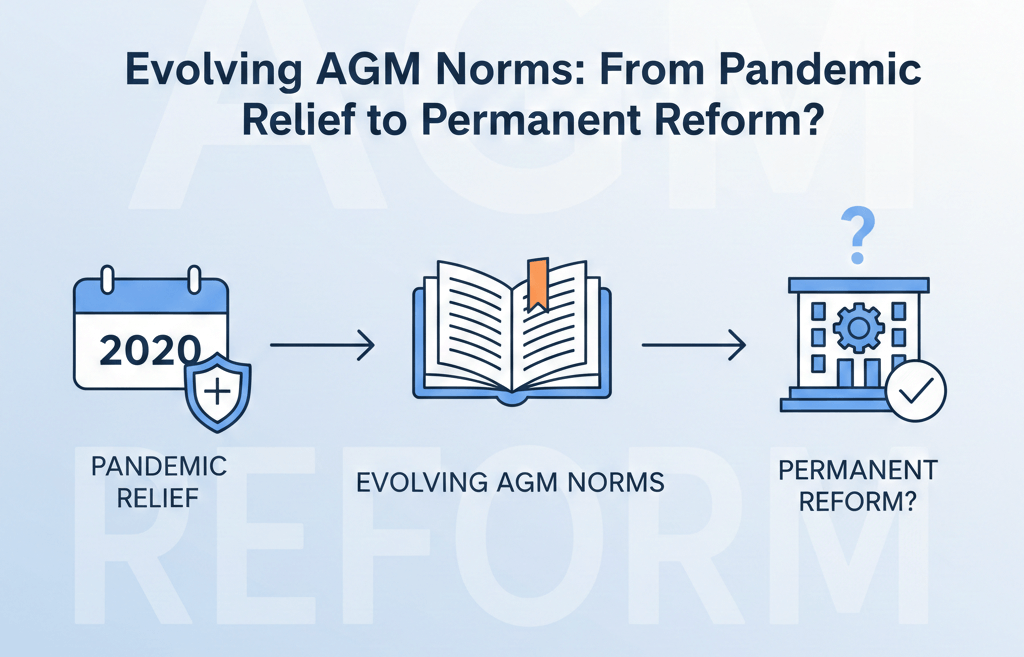
Although these circulars were originally issued for a specific time period, looking at the convenience it caused to the companies and stakeholders, MCA kept on extending the validity of the circulars. Last time MCA through an extension circular No. 09/2024 dated September 19, 2024, extended the validity of original circulars till 30th September 2025. Which meant that companies could conduct their general meetings through VC or OAVM till 30th September 2025.
Introduction:
Considering the fact that the validity of the original circulars permitting the conduct of general meetings through VC or OAVM was to expire on 30th September 2025 the MCA has once again extended the validity of the said circulars through an extension circular No. 03/2025 dated 22nd September 2025.
Key highlights of the circular:
Like the multiple circulars issued by MCA earlier, this circular also extends the validity of original circulars permitting the conduct of AGM and/or EOGM through VC or OAVM. However, the noteworthy difference is that this time the extension is not for any specific time period. Instead, the circular allows the conduct of general meetings through VC or OAVM till further orders. This means that companies can conduct general meetings through VC or OAVM till the time the ministry either issues any further direction in this regard or amends the provisions of Companies Act itself.
Impact on listed entities:
If a company is conducting its general meeting, extra ordinary general meeting or postal ballot through VC or OAVM then, it is not required to send the physical copies of financial statements to shareholders. SEBI vide its amendment notification dt: December 12, 2024, provided relaxation from compliance of this requirement.
As per reg. 36(1)(b) of LODR, listed companies are no longer required to send physical copy of statement giving salient features of financial statements to shareholders. Instead, they are required to send a letter giving link and QR code of the financial statements to the shareholders who have not registered their email IDs with the company. That means, the SEBI has already made the compliance requirements suitable for conduct of general meetings through VC or OAVM by amending regulation 36(1)(b).
Future possibilities.
In the year 2020, circulars permitting conduct of general meetings through VC or OAVM were issued considering the restrictions on movement of people and social distancing norms due to COVID-19 pandemic. But after observing the benefits and ease of doing business for companies as well as the shareholders, the recommendations were sent to the Company Law Committee constituted for recommending amendments to the Companies Act 2013. The committee considered the recommendations and in Para 8.5 of the Company Law Committee Report 2022 (CLC report 2022)gave the following suggestions.
“Owing to the multifarious benefits of relaxing the requirement for physical meetings, the Committee recommended amending suitable provisions of CA- 13 to enable the Central Government to prescribe the manner in which companies can hold AGMs and EGMs physically, virtually and in hybrid mode. It was also stated that where the meeting is for an EGM to be conducted entirely in electronic mode, the notice period for such meetings could be reduced to such period as may be prescribed by Central Government. The Committee proposed to empower the Central Government to prescribe detailed procedures and safeguards by way of Rules.”
Looking at this recommendation given by CLC report 2022 and the extension to circulars allowing conduct of general meetings by VC or OAVM given by the ministry for an indefinite period, it appears that the provisions of the Act relating to conduct of general meetings may soon see an amendment and the Act itself may allow the conduct of general meetings through VC or OAVM.
Conclusion:
With the indefinite extension to circulars allowing conduct of general meetings through VC or OAVM in place, companies must view VC/OAVM as more than a temporary relief measure. It is now emerging as a practical alternative to physical meetings. Therefore, boards should strengthen internal processes, shareholder engagement mechanisms, and technological infrastructure to ensure smooth and compliant conduct of such meetings going forward