
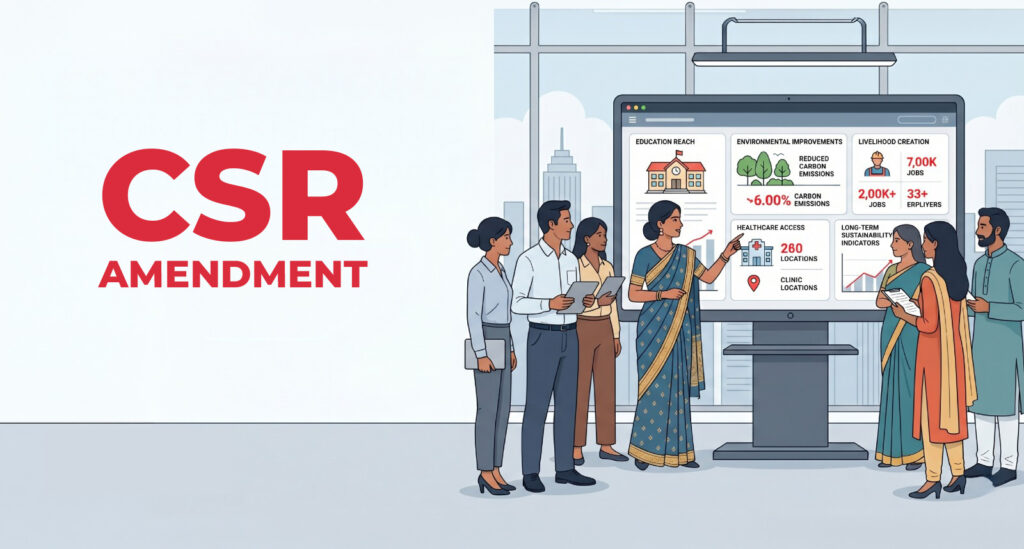
The Ministry of Corporate Affairs, vide notification G.S.R. 415(E) dated 27th May 2026, has allowed companies to carry out their CSR activities by subscribing to Zero Coupon Zero Principal (ZCZP) instruments issued by NPOs listed on the Social Stock Exchange. Let us understand how the amendment impacts the way CSR is implemented for Companies, NGOs and other stakeholders.
What is a ZCZP Instrument?
A ZCZP instrument is a security issued by an NGO registered on the Social Stock Exchange. Unlike the traditional shares and bonds which provide Interest and growth in principal value, these instruments don’t provide a financial return, and the money would be used for the social cause for which it is subscribed and will not be returned to the investor.
What is the Social Stock Exchange?
Social Stock Exchange (SSE) is a dedicated platform established by Securities and Exchange Board of India (SEBI) where social enterprises and non-profit organisations can raise funds from the public and investors. In India, the Social Stock Exchange operates as a separate segment under the BSE and NSE. It connects the organisations working for social cause with investors and donors who want social returns.
Expansion of scope of Schedule VII of Companies Act, 2013
The scope of Schedule VII of the Companies Act has been expanded by inserting a new item (xiii) — “Subscription to zero coupon zero principal instruments on Social Stock Exchange” — as a valid CSR activity. Further, in order to facilitate the implementation of CSR through Zero Coupon Zero Principal Instrument, amendment in the CSR Policy Rules, 2014 has been made wherein definition of ‘Not for Profit Organization’ and ‘Zero Coupon Zero Principal Instrument’ has been introduced in Rule 2 and the criteria for Corporate Social Responsibility implementation through zero coupon zero principal instrument has been enumerated in Rule 4A.
Who Can Issue ZCZP Instruments?
Only NPOs registered on the SSE can issue ZCZP instruments. To qualify, an NPO must meet the following conditions:
- Legally constituted as a charitable trust, registered society, or Section 8 company
- Operational for at least three years
- Valid income tax registration under Section 12A/12AA/12AB of the Income Tax Act, 1961 (Section 12AB/332)
- Obtain approval under Section 80G/133
- Minimum annual spending of ₹50 lakh and received at least ₹10 lakh in funding during the previous financial year
- At least 67% of activities must fall within SEBI’s eligible social activities list. (List given after this part.)
- Registered on the NGO Darpan portal
- Free from any debarment, wilful default, or government-imposed restrictions.
- Filed Income Tax Return (ITR) within timelines.
- Filed Audit Report within timelines.
Issue conditions:
Minimum issue size: ₹50 lakh (SEBI reduced the minimum issue size from ₹1 crore to ₹50 lakh to make SSE accessible to smaller NGOs.)
- Minimum subscription: 50% of proposed funds
Example:
Suppose an NGO wants ₹1 crore through a ZCZP issue.
The minimum subscription requirement means:
- At least ₹50 lakh must be subscribed.
- If less than ₹50 lakh is raised, the issue may fail.
- Money may be returned to subscribers.
- Issued in demat form (electronic form) only, for specific defined projects
- Project duration must not exceed three succeeding financial years from date of issuance.
(SEBI and MCA have restricted the tenure because it want ZCZP to have timebound outcomes, If projects continue indefinitely – Impact becomes difficult to measure, monitoring becomes complicated and funds may remain idle.)
For-profit social enterprises are recognised on the SSE but cannot issue ZCZP instruments — their fundraising routes are through equity, debt, or Social Impact Funds. ( Note – A for profit company can distribute profits and can provide returns to investors and ZCZP gives no return, no principal repayment, exclusively for public welfare only.)
The Social Enterprise shall be indulged in at least one of the following activities:
- eradicating hunger, poverty, malnutrition, and inequality;
- promoting health care including mental healthcare, sanitation and making available safe drinking water;
- promoting education, employability, and livelihoods;
- promoting gender equality, empowerment of women and LGBTQIA+ communities;
- ensuring environmental sustainability, addressing climate change including mitigation and adaptation, forest, and wildlife conservation;
- protection of national heritage, art, and culture;
- training to promote rural sports, nationally recognised sports, Paralympic sports, and Olympic sports;
- supporting incubators of Social Enterprises;
- supporting other platforms that strengthen the non-profit ecosystem in fundraising and capacity building;
- promoting livelihoods for rural and urban poor including enhancing income of small and marginal farmers and workers in the non-farm sector;
- slum area development, affordable housing, and other interventions to build sustainable and resilient cities;
- disaster management, including relief, rehabilitation, and reconstruction activities;
- promotion of financial inclusion;
- facilitating access to land and property assets for disadvantaged communities;
- bridging the digital divide in internet and mobile phone access, addressing issues of misinformation and data protection;
- promoting welfare of migrants and displaced persons;
- any other area as identified by the Board or Government of India from time to time.
What Does This Mean for Companies?
For companies, the SEBI-mandated disclosure framework ensures,
- They receive verifiable, third-party validated proof of fund utilisation through a mandatory Social Impact Assessment.
- The company need not bear the effort of a separate impact assessment for the amount contributed through subscription to ZCZP instruments. Since ZCZPs are issued in demat form, they bring transparency and accountability to CSR giving by ensuring a clear, verifiable audit trail of every rupee contributed. And because funds are tied to specific projects, companies can direct contributions precisely to their chosen CSR theme rather than making open-ended grants.
- The CSR rules cap ZCZP-route spending at 10% of a company’s total CSR expenditure for the financial year. However, this does not limit the relationship with the NPO itself — companies can direct the remaining CSR funds to the same SSE-listed NPO through conventional routes, combining the accountability of the SSE framework with the flexibility of direct grants. In practice, the ZCZP route works best for the portion of CSR spend where impact proof and audit trail matter most.
What Does This Mean for NGOs?
NGOs have always relied on grants, donations, and CSR contributions to run their programmes. For NGOs, listing on the SSE and raising funds through ZCZP instruments opens access to a formal, regulated capital market for the first time. It now offers a new pool of funds — one that comes from corporates who increasingly prefer structured, auditable instruments over direct grants. SSE listing replaces the uncertainty of annual fundraising cycles with a more structured, credible process. The companies may increasingly prefer SSE-listed NPOs because of the accountability with listing.
Annual Compliance for Listed NPOs
Once listed, NPOs must meet the following ongoing obligations:
- Annual Impact Report: Filed with SSE within 90 days from the end of the financial year, covering social impact generated, key activities, interventions, and programmes, as assessed by a SEBI-recognised Social Impact Assessor.
- Financial Disclosures — General and governance disclosures are required to be filed within 60 days from the end of the financial year; audited financial statements are required to be filed by 31st October each year or before the due date of filing the income tax return, whichever is later; along with a quarterly Fund Utilisation Statement submitted within 45 days from the end of each quarter
Statement of Deviation: If funds are not utilised as per the stated project plan, the NPO must disclose the deviation to the SSE.
(Note – The NPO is required to disclose the same as part of its ongoing reporting requirements to the SSE.)
These disclosures are generally made through:
- Annual Impact Report (AIR)
- Annual Financial Disclosure
- Material Event Disclosures
The disclosure should be made immediately upon identification of a material deviation and certainly within the next mandatory reporting cycle prescribed by SSE regulations.
Listing Agreement Compliance: Ongoing adherence to the terms of the listing agreement signed with BSE SSE or NSE SSE. (In Simple words – A Listing Agreement Compliance means that once an NGO gets listed on the Social Stock Exchange, it agrees to follow certain rules and reporting requirements prescribed by SEBI and the stock exchange.)
- Registration Renewal: NPO registration on the SSE is valid for three years and must be renewed thereafter.
If the NGO does not renew its registration:
- The NGO ceases to be recognized as an SSE-listed NPO.
- It cannot raise funds through ZCZP instruments.
- It cannot issue new social securities.
- Existing reporting obligations continue until all listed projects are closed.
To continue benefiting from SSE, the NPO must apply for renewal before expiry and demonstrate continued eligibility.
When Does a ZCZP Listing End?
A ZCZP listing can be terminated under the following circumstances:
- Achievement of objective — when the project for which funds were raised is completed and a fund utilization certificate to that effect is submitted to the SSE.
This certificate is generally certified by:
- Statutory Auditor
- Chartered Accountant
- Expiry of tenure — when the project duration specified in the fund-raising document comes to an end.
On termination of listing of ZCZP, any unspent funds must be transferred to a fund listed under Schedule VII of the Companies Act, and a compliance report must be submitted to SEBI. This ensures that no funds raised for a social purpose are left unaccounted for, regardless of how the listing ends.
Note –
- The ZCZP listing ends when the project for which money was raised has officially finished and all reporting obligations are completed or Project Closed Prematurely or Non-compliance with SSE requirements, Misuse of funds or failure to submit disclosures.
- The Compliance Report ensures that:
- The NGO is transparent about remaining funds.
- The exchange knows where the money is.
- Donors can verify fund utilization.
- SEBI can monitor accountability.
The report generally includes:
- Amount unspent
- Reason for non-utilization
- Future utilization plan
- Transfer details (if transferred)
- Auditor certification
- Under SSE continuous disclosure requirements:
- The status of fund utilization is reported annually through the Annual Impact Report and financial disclosures.
- Material non-utilization or deviation should be disclosed as soon as it becomes significant.
- Final utilization and closure reporting is submitted upon project completion or termination.
Practically, NGOs should not wait until the end of the project if there is a substantial deviation. Early disclosure is expected to maintain transparency and compliance with SSE requirements.
Conclusion
ZCZP as a CSR instrument bridges the world of capital markets and social impact. It brings the discipline and structure of financial instruments into the CSR space — making social funding more transparent, more accountable, and more scalable. For NGOs that are ready to operate at this level of formality, it represents a meaningful opportunity to build long-term relationships with corporate CSR teams and access funding that goes beyond the traditional grant cycle