

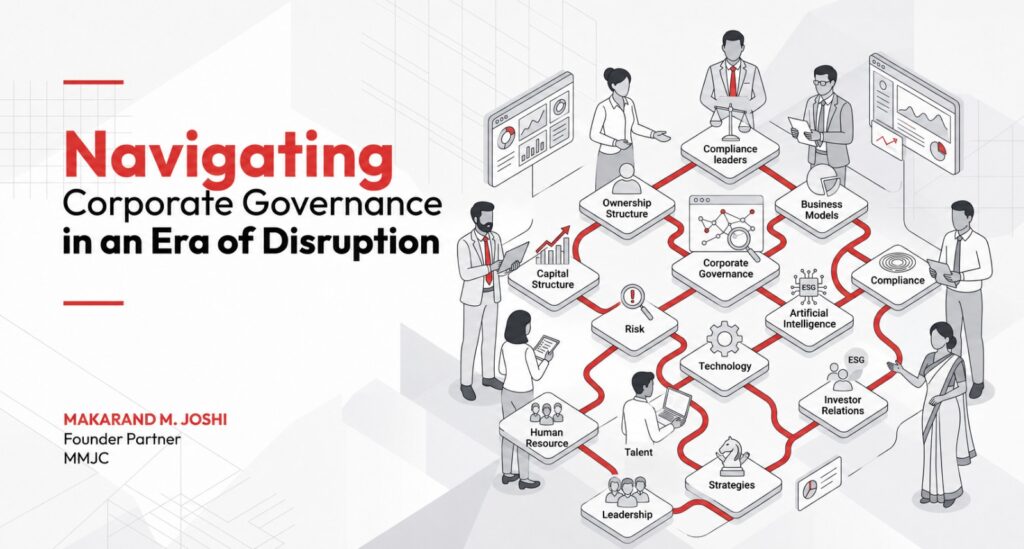
The modern corporate landscape is experiencing unprecedented disruption. Data consumption that once took a century now occurs within months. Business transformations that used to happen once a decade are now simultaneous, continuous realities. Driven by artificial intelligence, the digital revolution, rapid economic shifts, wealth redistribution, and an intense global focus on sustainability, the business environment is changing faster than ever. Because these macro-level disruptions fundamentally alter how industries operate, companies are forced to radically redesign their internal structures. For compliance officers, this means navigating a continuous ripple effect that begins with shifting corporate ownership and extends to everyday operational frameworks.
1. Changes in Ownership Structures:
India is witnessing a massive transition from promoter-led ownership to institutional investor-backed models, completely shifting the compliance paradigm. Where family-managed companies once relied on trust and informal, need-based documentation, investor-managed businesses demand strict policies, robust processes, clear rationale, and thorough record-keeping.
Furthermore, Indian promoter shareholding has largely transitioned from individuals to trust entities. This requires compliance officers to master the legal nuances of multiple jurisdictions. Without this deep understanding, navigating essential tasks like share transmission, Significant Beneficial Ownership (SBO) identification, and promoter group classification becomes impossible.
Similarly, new-age startups often lack a single controlling group, creating legal ambiguities. Regulators have yet to fully address questions like: Who is the actual promoter—the founder or the investor? Who exercises real control or significant influence? Can an individual with minimal economic interest still trigger SBO compliances? Compliance officers must proactively navigate these gray areas.
2. Changes in Business Models:
These ownership shifts, coupled with market disruptions, make business models highly volatile. This volatility makes financial forecasting unpredictable, causing threshold-based compliance requirements to fluctuate rapidly. Sectors like fertilizers, data centres, IT, and automobiles are undergoing massive structural shifts. These changes trigger reorganizations, altering management structures and re-designating key personnel under corporate and insider trading laws.
As business models shift, the definition of Price Sensitive Information (PSI) becomes highly dynamic. While regulators might only scrutinize these actions years later, compliance officers must pre-empt risks and align internal frameworks immediately. These shifts often spark mergers and restructuring, which disrupt reporting lines and lead to sudden executive turnover. This requires immediate regulatory filings and a concerted effort to induct and train incoming management. Additionally, corporate restructuring constantly alters the matrix of Related Parties and Related Party Transactions (RPTs), increasing the compliance burden. The compliance officer cannot be a passive spectator; they must be the strategic architect of agile compliance frameworks.
3. Changes in Memorandum and Articles of Association:
As these business models and internal structures reorganize, they inevitably demand immediate alterations to a company’s foundational legal charter. Consequently, the days when the Memorandum of Association (MoA) was referenced only in exceptional situations are gone. Dynamic business pivots mean the MoA must be reviewed and updated frequently. Similarly, the shift from promoter-led to investor-funded organizations requires significant overhauls of the Articles of Association (AoA) to govern new corporate behaviors. Compliance officers must meticulously draft these documents to prevent conflicting interpretations. As department leaders, they must also ensure their teams fully grasp the practical interplay between these foundational documents.
4. Changes in Capital Structures:
The revisions made to these constitutional documents are often driven by a fundamental shift in how corporations fund their growth. Despite India’s steady GDP growth of 6–7%, capital raising has surged over the last few years, fundamentally altering debt-to-equity ratios across industries. Decades ago, a 1:3 ratio was standard. Today—outside of capital-intensive sectors like infrastructure and aviation—equity capital has significantly outpaced debt. While this provides corporate stability, it compresses the return on capital, changing the entire corporate risk dynamic.
With companies launching more capital issues than ever, compliance professionals must adeptly manage these complex transactions. Simultaneously, regulatory processes for issuing capital have become much stricter. Decisions regarding pricing, timing, and investor selection must be thoroughly documented and justified to pre-empt future litigation or shareholder allegations.
On the debt side, banks are competing fiercely for deposits, the government is heavily promoting debt securities, and foreign currency loans are increasingly accessible. This environment requires a distinct compliance mindset focused on debenture trustee compliances, debt listing requirements, foreign exchange regulations, and insolvency risks. As banking transitions toward digital lending and NBFC-dependent models, lender priorities are shifting. Compliance officers—whether representing the lender or the borrower—must align their governance practices with the changing expectations of regulators, investors, and creditors. These expectations manifest in stricter asset-liability mismatch monitoring, enhanced CARO reporting, evolving credit rating parameters, and new pooled investment vehicles. Positioned correctly, this environment offers a massive growth opportunity for the profession.
5. Changes in CXO Tenures:
This continuous influx of external capital and the resulting demand for performance place intense pressure on executive management, fundamentally reshaping leadership stability. The era of lifelong, committed corporate executives is fading; attrition rates at the CXO level have risen sharply. In top-down corporate structures, this churn creates high volatility. As Indian companies transition from promoter-managed to professionally run enterprises, the fierce demand for talent has led to shorter CXO tenures and more transactional board expectations. For the compliance officer, this means the organization’s compliance culture must be institutionalized. It cannot depend on individual business leaders. It requires an agile approach to onboarding changing leadership, paired with an uncompromising stance on core governance frameworks to protect the corporate entity.
6. Changes in Talent Pool and Retention Strategies:
When leadership at the very top becomes highly transitional, it ripples downward, forcing a total rethink of how the entire professional talent pool is developed and retained. The supply of professional talent is shaped by shifting academic frameworks and societal perceptions of the profession. Conversely, demand is driven by increasing legal complexity, stricter enforcement, litigation, and technological disruption. To thrive, compliance leaders must embrace advanced regulatory technologies while aggressively investing in human capital. Understanding the evolving beliefs and workplace behaviors of younger generations, mapping them to industry expectations, and building robust learning and development structures is now an urgent priority.
Conclusion: Unlearning for Effective Adaptability:
While compliance deals with a defined universe of statutory laws, the execution of those laws must adapt to volatile macroeconomic factors. Therefore, unlearning past methodologies is critical. What succeeded yesterday guarantees nothing for tomorrow. Because the human brain relies naturally on familiar memories and patterns, intentional unlearning is the hardest hurdle to clear when trying to adapt. Compliance professionals must master this mental shift—maintaining operational peace while executing dynamic, deeply reflective governance strategies.
This Article written by
CS Makarand Joshi – Founder Partner,
Founder Partner, Makarand M. Joshi & Co