


Introduction
Those were the days when company secretaries [whether in practice or employment] used to remember amendments by dates, those were the days when amendments used to require approval of parliament and wrongdoer required trial via long-drawn court process to get convicted.
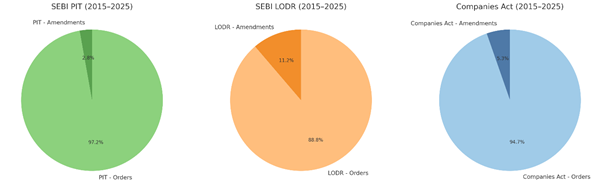
Cut two, in last 10 years [‘2015-2025’] we have seen 212 amendments in Companies act, 2013 (including act and rules), 38 amendments in Securities and Exchange Board of India (Listing Obligations and Disclosure Requirements), regulations, 2015 [‘SEBI LODR’] regulations and 13 amendments in PIT regulations. We have seen 3761 number of orders getting passed by MCA and 300 plus and 450 plus orders passed by SEBI under adjudication process under SEBI LODR and Securities and Exchange Board of India (Prohibition of Insider Trading) regulation 2015 [‘SEBI PIT’] respectively. Pie chart depicting same is specified below:
Evolving expectations and priorities for a knowledge professional
When I started my career 25 years ago, reading and awareness about commentary written by great stalwarts was considered as knowledge and there was a good amount of literature available in commentary format. In the last 10 years so much has changed and law has become so dynamic that the shelf life of any commentary has significantly diminished due to continuous changes in law and therefore focus of professionals should shift from knowing the provisions of law to ability to interpret. However, law kept changing very fast and now interpretation is also not adequate. A professional in the corporate secretarial domain needs to imbibe many more aspects like effective policies, processes, technology, project management, technology etc. to be effective. Practicing company secretary has role to play to help company secretaries in employment to cope with this aspect. A lot of the CS’s energy in corporate goes in stakeholder management and therefore there is opportunity for a Practicing Company Secretary [‘PCS’] to assist his fellow friend working in corporate.
Areas for collaboration – PCS and CS in employment
There are 5 broad areas where PCS can support corporates [apart from audit, attestation, and outsourcing services] –
- Helping in framing, drafting policies, and assessing its impact
- Designing, documenting, reviewing processes
- Helping in getting alignment of internal stakeholders for compliances
- Enabling technological interventions
- Representing and replying to inquiries and scrutiny
Policies and procedures
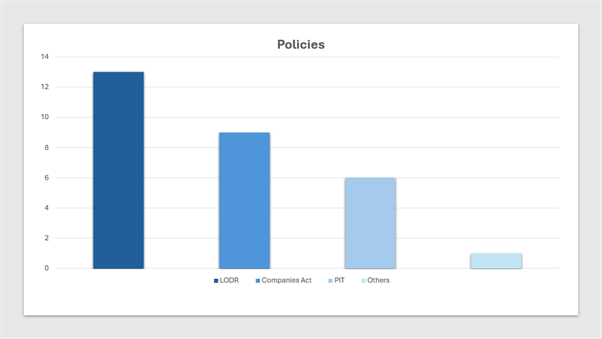
Under SEBI LODR, 13 policies are required to be adopted by the board of directors of a listed entity. Below chart provides number of policies required to be framed under SEBI LODR, companies act and PIT:
Generally secretarial departments in corporates frame these policies. This is a great opportunity for company secretary to move from just a compliance officer to policy maker and truly occupy the post of one level below board of directors as envisaged under regulation 6 of SEBI LODR. Most of the times these policies lack careful drafting. If thought over well, this is clearly an opportunity to stand out. Good policy framework not only helps to call out understanding of some key terms in corporate laws [where there are multiple meanings eg. What is UPSI or what is start date of UPSI, what is purpose and effect under RPT], it also gives opportunity for board members to clearly reflect what they stand for. For example, in code of conduct for dealing in securities of listed entities by designated persons and their immediate relatives framed under regulation 9(1) of PIT Regulations some companies had mentioned about clear ban on dealing in F & O corresponding to scrips of listed entity. In policy for identification of material subsidiary framed under regulation 16(1)(c) of SEBI LODR some companies had gone beyond statutory requirement of 10 or 20% of consolidated turnover and had covered even balance sheet items for identification of material subsidiary. Dividend distribution policies of some companies framed under regulation 43A of SEBI LODR clearly give a picture to the investor about philosophy of company to distribute surplus amongst shareholders.
Policies clearly differentiate between a Man and a boy. Policies clearly reflect on depth of secretarial department and even upon board of directors of that company.
Policies also act as defence when it comes to any allegation made by whistle blower or regulator, because the policies are very well thought and within framework of law. In grey areas of interpretation, policies and processes also give reasoning to the decisions made by board and management and thereby charges of arbitrariness or acting in interest of stakeholders get eliminated.
Consistent policies also give freedom, assurance, and protection to management.
A practising company secretary can help corporates in studying data about industry and various companies about Policies. PCS can help corporates to choose appropriate objective/ goal, assess changing outside world v/s internal culture – structure strength of organisation and then accordingly frame policies to achieve objectives. Since these policies can be available to public, these policies will help attract right investors, talent and help alignment of stakeholders faster and longer while mitigating lot of risks.
Processes and Technology
Corporate law [both companies act and SEBI LODR] has become so complex that intention and policies alone cannot get you there. For that we need robust processes and at next level technologically advanced processes. For effective implementation of compliances like related party transactions [RPT] require multiple robust processes. For example – process of identification of related parties, mapping transactions with related parties (directly or indirectly), processes to identify transactions where a Related Party (‘RP’) can be indirectly benefited, framework for onboarding RPs, processes about ascertaining best interest for company, processes for data collation, processes of reporting, processes of frequent audits, processes of whistle blowers about RPT and many more. These processes collectively become comprehensive compliance management system.
There are quite a few corporates who seek help of professionals in streamlining these processes which are appropriate for them and meeting the expectations of regulators and law makers. PCS has a great opportunity to develop mastery in streamlining these processes and take corporate secretarial functions to various process related accreditations like ISO. Secretarial department doing ISO for it’s quality processes and for data protection can give lot of comfort to various stakeholders. In case of any enquiries from regulators about any probable violation of RPT or PIT or CSR or Code of Conducts or Policies, these processes can prove bona fide intention of fiduciaries and can act as ring fence at many times.
Processes, particularly those enhanced by technology, can also bring a lot of ease and comfort about compliances not only to secretarial team but also to board of directors. Imagine that using technology if related party is identified via disclosures from all concerned parties, a dashboard presented to audit committee about this, how reassuring that would be! If via vendor, distributor, employee onboarding processes are tagged, and no vendor/ distributor/ employee can be onboarded if he/ she is RP! Such a comfort giving thing to every fiduciary!! PCS can help in streamlining this and even anchoring this, further being a custodian of these processes. This can bring lot of credibility to profession and great utility to industry. RPT, PIT, CSR, Whistleblower, board, and committee meeting processes are very demanding, and PCS can bring lot of ease to it.
Stakeholder Engagement
No longer secretarial field can work in isolation. Be it RPT, PIT, SAST, Reg. 30, ESOP, CSR, Meetings, stakeholder engagement – alignment – and responsibility sharing has become a key for performance of company secretary. PCS can help corporates in conducting trainings, communication strategies, KPI framing to take care of these compliances, and propagation of its importance to senior management – executive directors and overall board of directors. Story telling techniques – engaging presentations – communication collaterals – learning management techniques – new generation engaging tools like gamifications / animations / bots can bring lot of acceptability to these efforts and PCS is equipped to help in this as important player.
My experience tells me that with these efforts, perception of senior management towards company secretary profession can change dramatically.
Conclusion
It is a high time PCS must move beyond certification/ attestation/ outsourcing services. PCS should become partner of his fellow in corporate. This partnership between corporate and PCS will bring lot of sustainability in practices, help corporates position well, protect well, attract good investors, bring ease in compliance, and win credibility