


IEPF Compliance: A Practical Timeline from Declaration of Dividend to Transfer
IEPF compliance is often perceived as a straightforward regulatory task when looking at individual sections of the Companies Act, 2013. However, putting all the requirements together in practice frequently leads to confusion. Key provisions under Sections 123, 124, and 125, alongside the Investor Education and Protection Fund Authority (Accounting, Audit, Transfer and Refund) Rules, 2016 (“IEPF Rules”), mandate that any unpaid dividend amounts or unclaimed underlying shares must eventually be transferred to the IEPF Authority.
Declaring a dividend—whether interim or final and paying it out within 30 days of declaration does not mark the end of a company’s obligations. Instead, it triggers a chain of event-driven and compliances involving record maintenance, public disclosures, regulatory filings, and corporate actions. Understanding the practical workflow requires mapping out what happens at each stage of the dividend lifecycle.
To simplify the entire timeline from declaration to final transfer, the workflow below details how unpaid dividends and corresponding shares move through statutory timeframes:
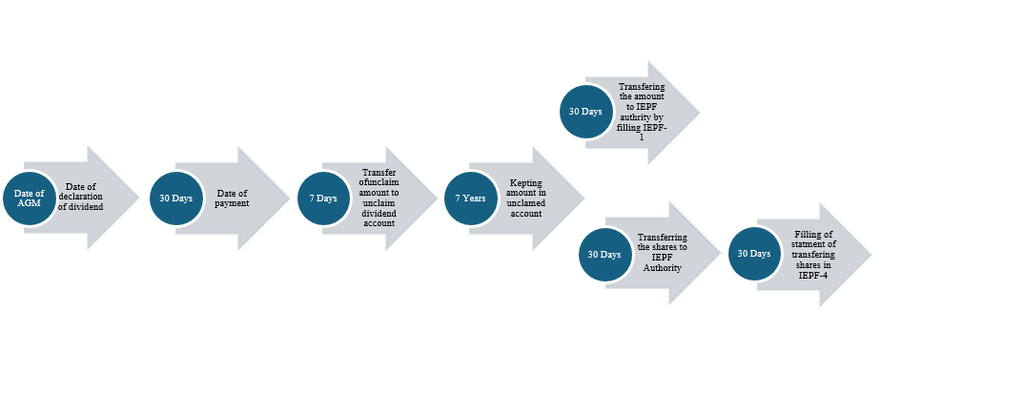
The above timeline captures the key milestones in the journey of unpaid dividend and the corresponding shares. While IEPF-1 and IEPF-4 form part of the transfer process shown above, there are other IEPF forms which come into the picture at different stages or in specific situations. The practical aspect of these forms is therefore better understood by looking at their purpose, applicable timeline and the points that require attention while filing them.
Practical Challenges & Compliance Matrix
Apart from event-based transfers, several annual statements, restrained transfers, secondary remittances, and claim processes require continuous tracking. The table below outlines these additional statutory forms, their timelines, and critical practical challenges to keep in mind:
| Sr. No. | Form | Statutory Timeline | Purpose / Workflow Explanation | Practical Challenges & Key Points to Keep in Mind |
| 1 | IEPF-2 | Within 60 days from the holding of the Annual General Meeting (AGM) or the date on which it should have been held. | Serves as an annual statement detailing all unpaid and unclaimed amounts lying with the company as on March 31st of the respective financial year. | • Shareholder-wise details and amounts must strictly reconcile with company records and RTA records. • For listed entities, details must also reconcile with the Shareholding Pattern filed for the quarter ended March 31st. |
| 2 | IEPF-3* | Within 30 days from the end of the financial year. | Filed to furnish details of shares and unpaid dividends that the company cannot transfer to IEPF due to specific restraining orders from a Court, Tribunal, or Statutory Authority. | • Companies must correctly identify affected shares and retain complete copies of legal/tribunal orders. • A copy of the restraining order must be attached to the form as documentary proof. |
| 3 | IEPF-1 | Within 30 days from the date the unclaimed amount becomes due for transfer (after completion of 7 years). | Filed for remitting unclaimed dividend amounts to the IEPF Authority. | • V3 Portal Alert: Do not transfer funds directly to the IEPF authority before filling/initiating the form. Under the MCA V3 portal, remittance is processed directly through the form submission workflow. |
| 4 | IEPF-4 | Within 30 days of corporate action completion with depositories. | Reports the corporate action and transfer of underlying shares to the demat account of the IEPF Authority. | • Ensure newspaper publication is issued at least 3 months prior to the due date, as a copy must be attached to the form. • Verify that shareholder master data matches depository records prior to executing corporate action. |
| 5 | IEPF-5 | No specific time limit (driven by shareholder initiative). | Filed online by a shareholder to claim refund of dividend amounts or underlying shares from the IEPF Authority. | The form automatically reflects on the company’s V3 portal account for verification. However, company should prepare their V3 ID on MCA portal and have a regular check on the same. |
| 6 | IEPF-5 EVR | Within 30 days of receiving physical claim documents from the shareholder. | e-Verification Report filed by the company’s Nodal Officer communicating whether the shareholder’s claim is accepted or rejected. | • Must be filed exclusively through the V3 ID of the designated Nodal Officer (as registered in Form IEPF-2) • Delays in verification attract strict monitoring from the IEPF Authority. |
| 7 | IEPF-7* | Within 30 days of payment becoming due. | Filed for reporting secondary amounts (such as bonus dividends, interim payments, or corporate action proceeds) accruing on shares already transferred to the IEPF Authority | • V3 Portal Alert: Amount accruing on shares already with IEPF must not be remitted directly prior to filing. Under V3, payment must be routed through the online form filing module. |
*As per the MCA amendment dated July 16, 2024, Form IEPF-3 has been merged into Form IEPF-4, and Form IEPF-7 has been merged into Form IEPF-1.
Conclusion
Managing IEPF compliances is an ongoing operational duty rather than an isolated annual event. From maintaining aligned investor records with the RTA to handling MCA V3 portal transitions correctly, secretarial teams must maintain strict timeline tracking. By systematically following the 7-year timeline and maintaining data reconciliation across quarterly reports, AGM disclosures, and event-based filings, companies can prevent regulatory notices and ensure smooth claim resolutions for investors
The article is written by Himanshu Jain.