
Introduction.
The Securities and Exchange Board of India (SEBI) notified the Infrastructure Investment Trust regulations 2014 (InvIT regulations) on 26th September 2014 and the regulations became effective on the same day of its notification. That means, in September 2026, the InvIT regulations are completing 12 years in operation.
The InvIT regulations have travelled a long way from a new, sponsor owned, pooled infrastructure investment vehicle, to a well governed sophisticated investment option with a large investor base. Through this article, let us try to understand this journey through amendments made to the regulations.
WHAT AMENDMENT NUMBERS SHOW
SINCE ITS ENACTMENT IN September 2014, the InvIT regulations have been amended 20 times till date. This number relates exclusively to amendments made to the principle regulations and does not include the procedural changes made through circularsor other delegated legislatures. following is the pictorial presentation of amendments introduced in each year.
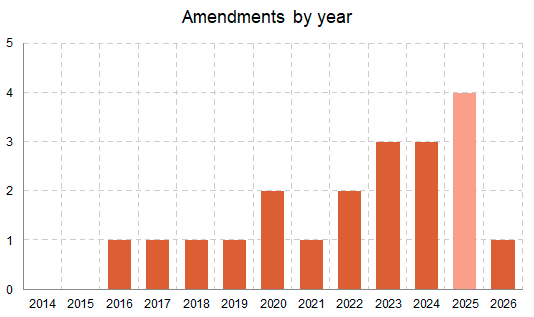
The chart shows a clear rise in amendment activity after 2019, reaching its highest level in 2025 with four amendments. The 2026 figure is only up to 17 April 2026, the date of the latest amendment considered.
Trend analysis
Other then the numbers, the amendments also show a particular trend over the span of 12 years. The amendments cover key aspects like investor protection, strong corporate governance, ease of doing business etc. the following table depicts the trend demonstrated in the amendments brought about by SEBI.
Amendment trend
| Period | Amendments | Broad regulatory phase |
| 2014–2015 | 0 | Creation and initial implementation |
| 2016–2019 | 4 | Market activation and removal of entry barriers |
| 2020–2021 | 3 | Capital-raising flexibility and broader investor participation |
| 2022–2023 | 5 | Governance, sponsor framework and investor protection |
| 2024–2025 | 7 | Product innovation, EODB and mature-market regulation |
| 2026 to date | 1 | Further rationalisation/EODB |
| Total | 20 |
- First one year period remarked the enactment of principle regulations and procedural compliance structure through circulars and guidelines etc.
- In the Span of Next 4 years, the SEBI made the InvITs commercially more workable. It introduced the HoldCo route, expanded fund-raising options and permitted listed debt issuance. It also widened the pool of private-placement investors and reduced certain public-offer thresholds. The 2019 changes allowed higher leverage, subject to safeguards. Together, these changes gave sponsors more ways to structure assets and raise funds.
- Amendments in years 2020-2021 Amed at Supporting growth and widening access. Rights issues gave listed InvITs another route to raise capital after listing. SEBI also addressed changes in sponsor or control and introduced protections for investors in those situations. In 2021, the lower public-offer application value and one-unit trading lot made publicly offered InvIT units more accessible to smaller investors
- In 2022–2023 as the InvIT structure matured, it can be seen that, SEBI shifted its focus towards Strengthening governance. It developed more detailed corporate-governance requirements, including provisions concerning auditors, leverage calculation and unclaimed distributions. It also reshaped the sponsor framework through graded sponsor holding, the self-sponsored investment manager model and provisions for special rights and board nominations. Investor grievance mechanisms and minimum public unitholding requirements received further attention.
- In 2024–2025, The framework expanded to cover subordinate units in privately placed InvITs and unit-based employee benefit schemes for investment-manager employees. Other changes addressed trading lots, voting and meeting procedures, sponsor-unit transfers, trustee responsibilities, investment conditions and operational funding. The Investor Charter also gave clearer regulatory recognition to investor rights and responsibilities. The trend observed in amendments suggests that, during this period SEBI Amed at Adding new features and refining operations.
- The April 2026 amendment dealt with liquid-asset eligibility, the status of an SPV after its concession expires, and permitted uses of funds. This is a more targeted refinement of an established framework. Other then this, SEBI in its board meeting dated 24th September 2026, has approved the amendment to InvIT regulations for permitting issue and listing of Depository receipts (DRs) by InvITs. Although the exact amendment to regulations is not yet notified, once effective the provisions will facilitate listing of Indian InvITs on IFSC and other foreign stock exchanges, further expanding investor bass and fund raising avenues.
Alignment with Equity Market
A further trend running through these amendments is SEBI’s gradual adoption of features familiar from the equity market for InvIT units. The framework now provides for private placement of units, unit-based employee benefit schemes and a one-unit trading lot for publicly offered InvITs. Further, the above-mentioned amendment with respect to issue of DRs further highlights this trend. Taken together, these steps make InvIT units easier to issue, hold and trade just like equity shares of listed companies.
Conclusion:
The amendment history of the InvIT Regulations tells a story of regulatory adaptation. SEBI first established the framework, then made it easier to structure assets, raise capital and attract investors. As InvITs developed, the focus widened to governance, sponsor accountability and unitholder protection. More recent changes have addressed specific operational needs and introduced features suited to a more established market.
The patterns demonstrated by the sequence of amendments to InvIT regulations suggests that SEBI is now refining a framework that has moved beyond its initial stage. For InvITs, the continuing challenge is to use the flexibility available under the regulations while maintaining the governance and transparency needed to earn investor confidence.
The article is written by Ms. Rutuja M Umadikar.